
With intermittent disruptions in the supply chain of raw materials from China, the Indian pharma industry has braced itself with bigger inventory. Even smaller drug makers are now carrying a month of buffer stock of key raw materials, said industry insiders. The lockdown in various Chinese provinces, including Shanghai, is likely to delay shipments by two weeks to a month, said domestic players. Shipments are critical for the Indian drug industry, which imports 70 per cent of its raw material from China.

The Centre has recovered around Rs 95.86 crore from at least 11 crypto exchanges for evading goods and services tax (GST), according to data released by Parliament on Monday. The amount includes interest and penalty. The GST investigation department has detected a total tax evasion of Rs 81.54 crore by crypto exchanges that include WazirX, Coin DCX, CoinSwitch Kuber, Buy Ucoin, UnoCoin and Flitpay, among other exchanges. In a written reply to Lok Sabha, minister of state (MoS) for finance Pankaj Chaudhary said 11 cases of GST evasion by cryptocurrency exchanges have been detected by central GST formations.

Stocks of Indian companies with exposure to Europe fell on Tuesday amid concerns about the impact on their sales in case the Russia-Ukraine crisis worsens and the US and its allies impose economic sanctions on Russia. While top conglomerates, including Reliance Industries, the Tata group, and Aditya Birla Group, said they did not have any significant exposure to Russia, executives of some of the oil and gas, pharmaceutical, and tea companies said they were monitoring the situation closely as they earned substantial income from the region. Russian President Vladimir Putin on Monday ordered troops into two breakaway regions of eastern Ukraine after announcing that Russia would recognise their independence.

While the infection has been mild in most reported cases, those below two years of age are showing signs of acute infection.

Adar Poonawalla says it took a five-minute chat with his father Cyrus before making the decision to manufacture Covishield. The bet paid off, and handsomely. Serum Institute now has the capacity to make 4 billion doses of Covishield annually.

The company had in December said that the CDSCO had approved a 12-month shelf life for Covaxin, which was nine months earlier, Sohini Das reports.

A back of the envelope calculation shows that India has roughly over 680 million doses of Covid-19 vaccines consisting primarily of Covishield doses.
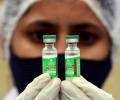
Serum Institute has the capacity to make 250 million doses of Covishield monthly.
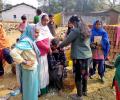
Bharat Biotech is targeting to manufacture one billion doses of its intra-nasal vaccine in 2022 which is under clinical trials now.

'Antibodies remain in the blood for at least seven to nine months.'

'Someone may have diabetes, but at what level the disease qualifies as a comorbid condition is something a doctor will decide upon and certify accordingly.'

If the vaccine is recommended for use as a booster against Omicron, it may significantly boost the demand for Covishield in India.

As the Omicron variant of Sars-CoV-2 takes centrestage, vaccine makers in India are of the view that scaling up the existing vaccines to make them more effective is possible.

The share of total health expenditure as part of the gross domestic product (GDP) went down to 3.3 per cent in 2017-18 from 3.8 per cent in the previous two years, according to the national health account data released on Monday by the health ministry. The share of government expenditure as part of total expenditure as well as GDP has gone up from from 3.78 per cent to 5.12 per cent between 2013-14 and 2017-18, which could also explain a decline seen in out of pocket expenditure in 2017-18. Health ministry also emphasised the increase in the government health expenditure as part of the total GDP from 1.15 per cent in 2013-14 to 1.35 per cent in 2017-18.

After ramping up production to meet the steep demand spike during the Covid-19 pandemic, Indian medical device makers are now struggling with idle capacity. According to industry estimates, around a third of the installed capacity, especially for consumables, disposables, small-ticket electronic items, etc., is lying unutilised. Sample this: India used to produce just 6.24 million pieces of PPE kits per annum before the pandemic, but by June this was ramped up to 233.87 million pieces per annum.

'Antiviral treatment will have no change. Spike protein change may affect the immunity protection.'
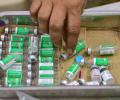
With around 2 million Covid vaccine doses likely to get wasted in December, leading hospital chains have now started to give it gratis to citizens. Sohini Das and Ruchika Chitravanshi report.

A nasal vaccine, one expert said, is a "fantastic idea" for two reasons -- one, it can potentially create sterile immunity, and two, it is easy to administer and thus scalable.
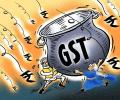
'We have already given Rs 1.59 trillion to states.' 'So, there is no question of giving them more.'

The central government is likely to exceed the budgeted tax collection target of Rs 22.2 trillion for the current fiscal year, led by better indirect tax mop-up, compliance measures, and recovery in most sectors following the second wave of the Covid pandemic. Personal income and corporate tax collections (net of refunds) grew 74 per cent to Rs 5.70 trillion in the first half of the current financial year, driven mainly by advance tax and TDS payments. The target for the current fiscal year is Rs 11.08 trillion; higher taxes are paid usually towards the end of a fiscal year.
 © 2026 Rediff.com - Investor Information - Advertise with us - Disclaimer - Privacy Policy - Sitemap - Feedback - About us - Terms of use - Grievances